Haeone Son’s practice is defined by an uncommon parity between technical rigor and conceptual inquiry. Now based in New York as a fashion designer and technical patternmaker, Son has converted increasingly bold conceptual prompts into production‑ready objects without sacrificing structural integrity. The centerpiece of this approach is perhaps most visible in the integrated hair wig work he produced for Meruert Tolegen’s Fall/Winter 2026 season. The project—conceived as a hybrid between garment and coiffure—required both precise pattern architecture and hands‑on material work: sourcing nontraditional wig materials, trimming hair sections to conform to three‑dimensional pattern contours, and executing multiple prototype sewings to calibrate tension, drape, and seam integrity.
Son’s contribution extended beyond the responsibilities of a conventional patternmaker. He assumed creative and technical ownership of runway pieces, orchestrating material selection and experimental assembly while producing repeatable production patterns. That dual authorship—where ideation and method are reciprocally informing—allowed the design team to move from concept to final fitting with a level of structural certainty rare in experimental runway work. The jacket’s exposed attachment points and visible anchoring systems were not mere effects; they were the resolved outcomes of an engineering process that prioritized durability, wearability, and legibility in motion.
Son’s method draws heavily on historical garment engineering as a basis for contemporary experimentation. Research into corsetry and vintage dress construction functions as a structural lexicon rather than a retrograde citation: by interrogating boning placement, internal channels, and historical shaping techniques, he builds a framework that can accommodate radical surface interventions such as integrated wig elements or unconventional textile manipulations. This is not pastiche but a disciplined reallocation of archival strategies to accommodate new materials and gestures.
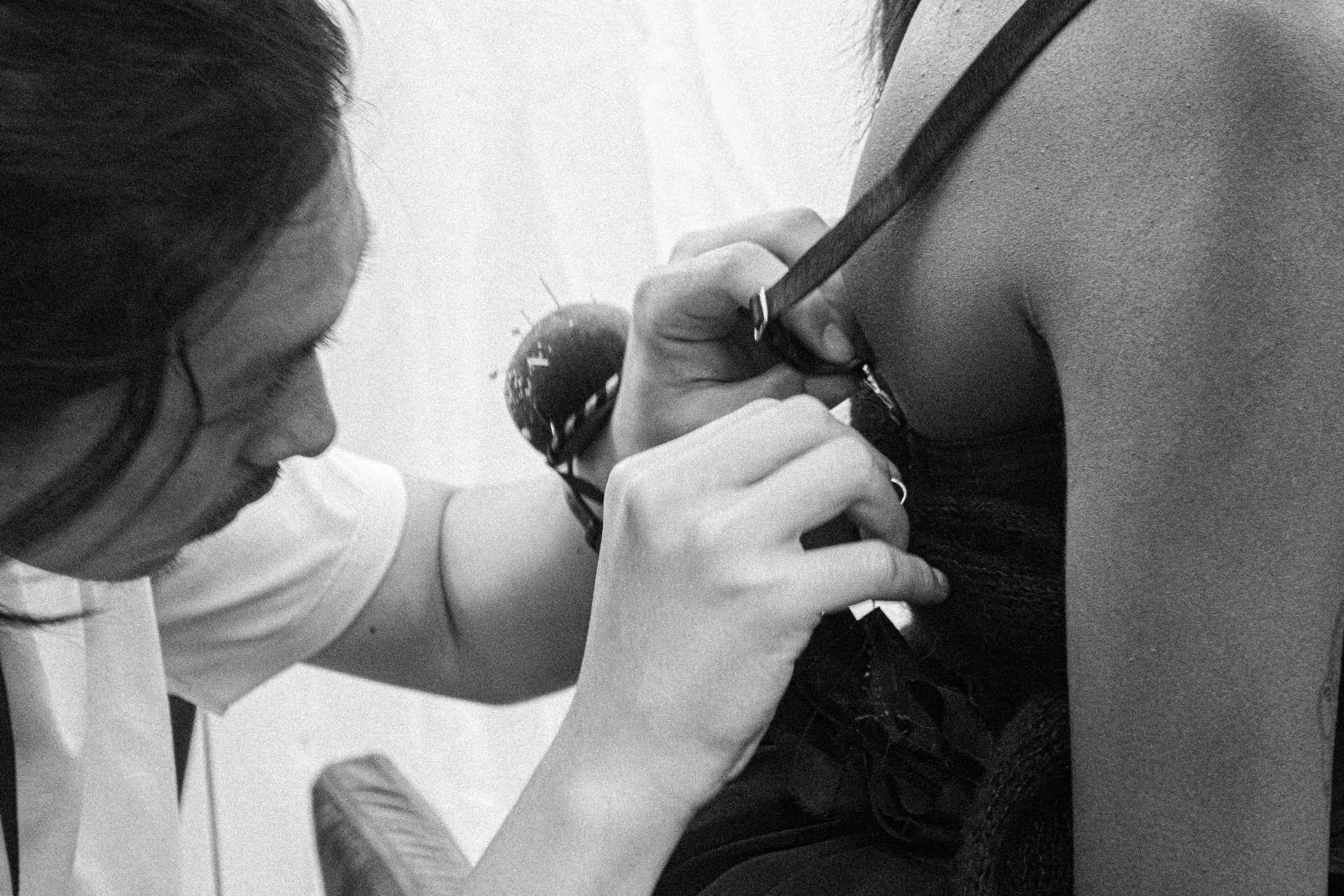
In practice, Son tailors internal architecture—interfacings, supports, and anchoring systems—with the same attention he affords visible seams and hems, producing silhouettes that resolve conceptually demanding gestures into viable luxury product. The implicit lesson of these studies is straightforward: when foundational construction is precise, surface experimentation can be legible, repeatable, and compatible with luxury manufacturing standards.
Son’s technical fluency has been exercised across both atelier‑scale and larger retail contexts. As a consultant for ARIAS New York, he concentrated on fit refinement and pattern development for contemporary, art‑informed womenswear—work that demanded meticulous measurement iteration, block development, and graded scaling logic. Those engagements required him to translate bespoke fitting protocols into patterns that could be reliably reproduced while preserving the original design intent.
At Madewell, Son applied comparable sensibilities to menswear, demonstrating an ability to translate meticulous construction techniques into systems suitable for higher‑volume production. The movement between these scales—boutique refinement and commercial repeatability—constitutes a throughline in Son’s portfolio: a designer who engineers for the runway but thinks in terms of reproducible quality and industrial tolerances.
Operating under the independent label Reunited, One, Son has executed custom wardrobe commissions for public figures while simultaneously building infrastructure for broader market engagement. The atelier’s bespoke work includes commissions for Grammy and Tony Award‑winner Daveed Diggs and actor Joshua Odjick, projects that foreground a tailored, narrative approach to dressing for editorial and stage contexts. These commissions illustrate Son’s capacity to balance individual client narratives with precise technical execution.
Parallel to bespoke practice, Son has invested in physical and digital studio infrastructure in Brooklyn to enable direct‑to‑consumer scaling. The forthcoming collection—planned to be constructed entirely from curated deadstock fabrics—signals an intent to reconcile sustainability, material scarcity, and the exacting standards of luxury construction during a transition from made‑to‑measure commissions to small‑batch commerce. This operational shift reframes the atelier as a site of both artisanal production and systems thinking.
Son’s role as a technical lead has repeatedly required translating conceptual silhouettes into production snapshots that maintain design intent. His work with ASHLYN during the label’s FW24 development exemplifies this competency: Son converted complex silhouettes into structurally precise production samples that attracted international attention. The samples he engineered functioned as clear communication tools—legible artifacts that allowed patternrooms and manufacturers to reproduce challenging designs without dilution.
That capacity to operate as a bridge—between conceptual designers, patternrooms, and ready‑to‑produce units—has become a defining contribution within New York’s technical ecosystem. It is a role that privileges accuracy, documentation, and iterative sampling as the primary means by which avant‑garde ideas transition into repeatable product.
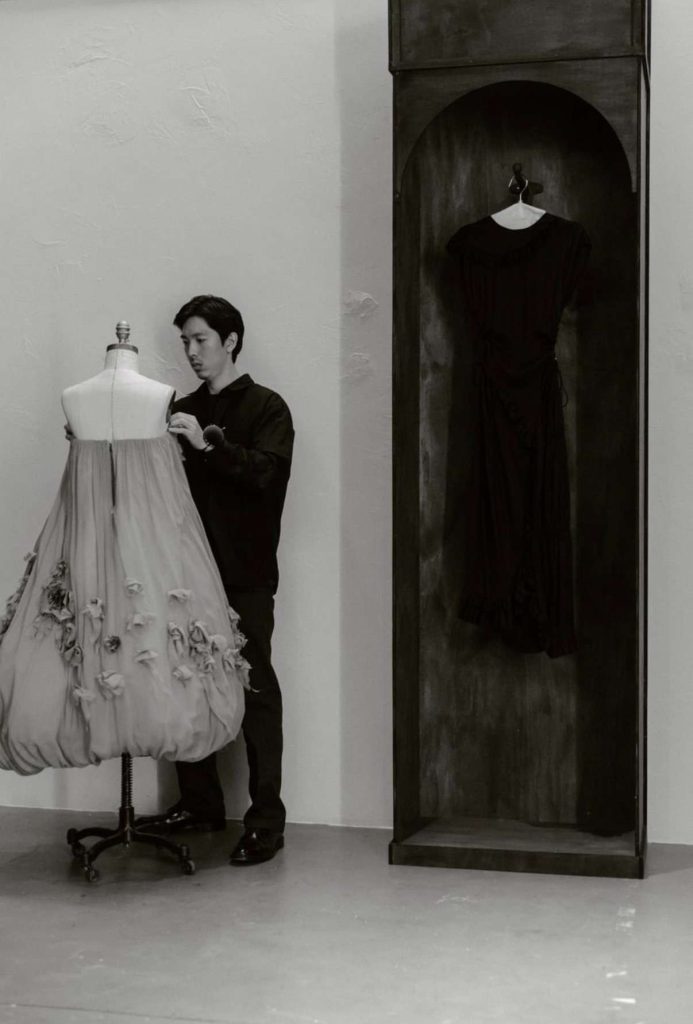
Son’s portfolio is accompanied by formal recognitions and process innovations that underline his dual commitments to craft and method. His award record includes a win in the ‘Men’s Casual Fashion’ category at the International Design Awards (IDA), a Gold Winner distinction at the MUSE Design Awards, a victory at the French Fashion Awards, and a 2026 win at the New York Product Design Awards for the Improv collection—work that employed his proprietary Stitch Resist Garment Dyeing technique. These distinctions map onto a wider pattern of technical contribution: the iterative development of a dyeing method that negotiates stitch‑based resist structure and surface alteration, and an ongoing commitment to problem solving at the intersection of process and aesthetics.
Beyond prize lists, Son’s editorial and commercial validation—ranging from entries into concept stores such as LRC (Lydia Rodrigues Collection) to the visibility of samples in international titles—speaks to how technical clarity can function as a form of cultural translation. When a sample reads without caveat, publications and buyers can apprehend a design’s potential on its own terms.
The significance of Son’s work lies in the way technical exactitude becomes an aesthetic engine rather than a corrective afterthought. His investigations do not simply mask the difficulty of execution; they foreground difficulty as an element of design language. The FW26 hair wig jacket, for example, exposes seams and attachment logics in ways that make the object legible at both close range and in motion on the runway. Those visible systems operate as both evidence of labor and as compositional strategies.
Son’s historical groundwork—corsetry and vintage construction—provides a disciplined grammar for surface experiments, granting those experiments a predictable mechanical behavior. In an industry often divided between conceptual runway excess and pragmatic commercialization, his practice proposes a continuum: experimental surface work and reproducible fit coexist through disciplined pattern engineering. The result is work that can satisfy curatorial scrutiny while remaining translatable to manufacturing pipelines.
Haeone Son’s trajectory is not reducible to a list of credits; it is a model of practice where handcraft meets systems thinking. Whether he is prototyping a hair‑integrated jacket for Meruert Tolegen, refining fit for ARIAS New York, or plotting the growth of Reunited, One into a digitally capable atelier, Son’s hallmark is a refusal to let conceptual ambition outpace constructional resolution. In doing so he advances a contemporary craft idiom—one that privileges technical clarity as both a professional imperative and a source of expressive possibility.