

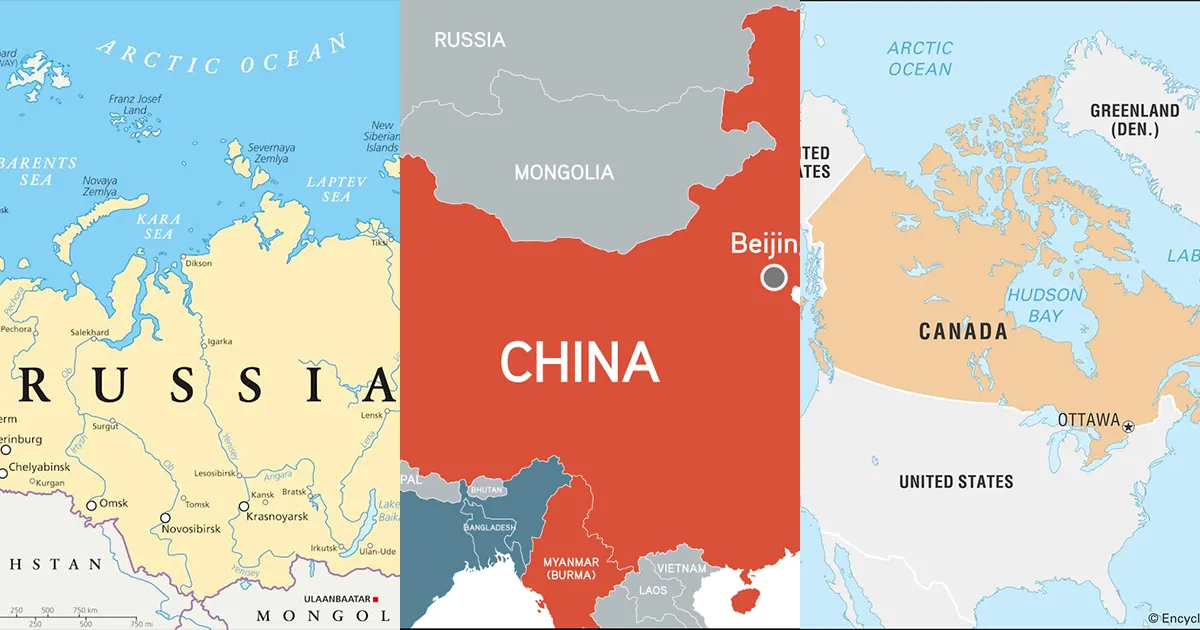
At Vogue Vocal, we are fascinated by scale because scale shapes reality. A country’s size affects how far food travels, how climates shift across borders and how people experience everyday life. When someone searches for which is the largest country in the world, they are not just asking for a name—they want to understand why some nations feel powerful, distant or endlessly complex. Land changes how governments govern, how economies grow and how cultures evolve.
Additionally, the largest country in the world by area carries both advantages and pressure. Bigger land means more resources, longer borders, and wider climate extremes. It also means harder transportation, bigger regional differences and higher responsibility on the global stage. Size is not just geography—it is influence, identity and opportunity shaping millions of lives at once. Before exploring the 10 giants in detail that truly rule the map, let’s have a quick sneak peek.
Quick Size Snapshot: The Largest Country in the World Rank
| Rank | Country | Total Area (mi²) | Total Area (km²) |
| 1 | Russia | 6,601,665 | 17,098,242 |
| 2 | Canada | 3,855,103 | 9,984,670 |
| 3 | China | 3,705,407 | 9,596,961 |
| 4 | United States | 3,796,742 | 9,833,520 |
| 5 | Brazil | 3,287,956 | 8,515,767 |
| 6 | Australia | 2,968,464 | 7,692,024 |
| 7 | India | 1,269,219 | 3,287,263 |
| 8 | Argentina | 1,073,500 | 2,780,400 |
| 9 | Kazakhstan | 1,052,089 | 2,724,900 |
| 10 | Algeria | 919,595 | 2,381,741 |
So, now let’s dive deep into the largest country in the world one by one.
Russia is the biggest country in the world, stretching across eleven time zones and multiple climate zones. From the icy tundra of Siberia to the fertile plains near Moscow, its landscapes are vast and diverse. Sparse populations inhabit frozen regions but the country’s size brings unparalleled natural wealth—oil, gas, timber and minerals. Russia’s geography presents logistical challenges for transportation, communication and defense. Spanning both Europe and Asia, it wields a unique transcontinental influence. From Arctic shores to Black Sea ports, Russia’s landmass shapes global politics, trade and strategy.

Canada is the second largest country on Earth, yet its vast north feels almost untouched. Most Canadians live near the U.S. border, while endless forests, tundra and Arctic islands dominate the north. The country holds more lakes than any other nation which supports hydroelectric energy and freshwater resources. Furthermore, extreme climates—from coastal rainforests to frozen plateaus—test human adaptation. Many areas remain accessible only by air. Canada’s size influences population distribution, natural resource management and its global environmental role, making it a quiet giant on the world stage.

China covers deserts, plateaus, fertile river basins and mountains which creates the extreme geographic diversity. The west features high altitude deserts and the Tibetan Plateau while eastern cities flourish on fertile plains. Despite a massive population, large areas remain lightly settled due to challenging terrain. China borders 14 countries which gives it strategic geopolitical complexity. Its land supports the agriculture, mining, industry and military positioning. The country’s size underpins its economic power, regional influence and global superpower status which makes it a living example of how land shapes destiny.

The United States ranks fourth in land area, encompassing deserts, forests, plains and mountain ranges. Alaska alone accounts for a significant portion of the territory which offers vast wilderness and energy reserves. Hawaii adds tropical ecosystems and volcanic islands. Additionally, the U.S.’s geographic variety enables the agriculture, industry and infrastructure to coexist with natural landscapes. Its size contributes to economic diversity, cultural regionalism and global influence. From coast to coast, the United States demonstrates how sheer landmass affects opportunity, lifestyle and national power.

Brazil’s enormous land size, which contains about 60% of the Amazon rainforest, gives it dominance over South America. From dense jungles to savannas and wetlands, the country boasts the unmatched biodiversity. The majority of people and economic activity are found in the southeast, while the northern areas are still lightly populated. Brazil’s land supports the agriculture, mining and environmental conservation. Its size also poses challenges for infrastructure and social equality. At Vogue Vocal, we see Brazil as a prime example of how large geography drives environmental significance and resource management on a global scale.

Australia is unique as both a country and a continent, with most people living in coastal cities. The interior, known as the Outback, is arid, flat and sparsely populated. Its isolation produced flora and fauna found nowhere else on Earth. Australia’s landmass encompasses tropical, temperate and arid climates, supporting agriculture, mining and urban development. Much of its territory remains uninhabitable, yet the country’s size shapes identity, environmental policies and economic activity which makes it an extraordinary geographic powerhouse.

India is one of the largest and most densely populated countries in the world. From Himalayan peaks to southern tropical forests, its geography is incredibly diverse. Rivers like the Ganges and Brahmaputra sustain the agriculture and communities. Urban areas and rural settlements coexist closely which makes the resource management crucial. Furthermore, India’s size supports the cultural diversity, regional economies and agricultural abundance. Despite the challenges, its geography enables vibrant societies, dynamic cities and fertile lands to flourish across multiple climates and terrains.

Argentina stretches from subtropical wetlands in the north to subpolar tundra in the south. The Andes mountains create a dramatic western border, while the Pampas grasslands support agriculture and cattle ranching. Patagonia, in the south, remains rugged and sparsely populated. This long north to south span results in diverse climates and ecosystems. Argentina’s size allows simultaneous industrial agriculture, tourism and protected wilderness areas. Moreover, its landmass demonstrates how geographic variety supports economy, culture and natural heritage.

Kazakhstan is the largest landlocked country in the world, which is dominated by flat steppes and arid deserts. Its sparse population lives across vast distances, and cities are few but strategically important. Kazakhstan’s land holds oil, minerals and energy resources, giving it significant regional influence. Its size challenges infrastructure development and connectivity but enhances its geopolitical importance in Central Asia. Kazakhstan illustrates how a massive interior landmass can define the strategy, economy and regional identity.

Algeria is Africa’s largest country with most of its land covered by the Sahara Desert. Populations concentrate along the Mediterranean coast where conditions are temperate. Beneath the sands lie extensive oil and natural gas reserves, powering its economy and global energy influence. Infrastructure and human settlement are challenged by Algeria’s large and dry interior, which also increases regional strategic significance. The nation is a prime illustration of how geographic size may influence both logistical complexity and economic might.

We at Vogue Vocal see the largest country in the world not just as a map fact but as a lens into culture, resources and influence. Every giant from Algeria’s desert land to Russia’s vast tundras shows us how geography affects the everyday life, economies and world power. Understanding size helps you appreciate how nations operate, adapt and thrive. Whether you’re curious, planning travel, or just love a little worldly insight, these 10 giants prove that scale truly matters—on maps, in strategy and in style. Geography, after all, is the ultimate backdrop for life’s drama, and Vogue Vocal always brings it straight to you.
The top 10 largest country in the world are Russia, Canada, China, the United States, Brazil, Australia, India, Argentina, Kazakhstan, and Algeria.
No, Russia is the largest country in the world, and Canada ranks second in total land area.
The USA is the fourth largest country in the world, just after Russia, Canada, and China.
Indonesia is the smallest country among these great giants.

Are the men in house ready to take their style game up a notch? Aly at Vogue Vocal is the eyes and ears of entertainment industry with that Gen-Z x-factor! Aly’s personal style statement raises the bar high and knocks it out of the park so trust him for picking the best for Vocal Fashion, our e-magazine edit, the heart and soul of Vogue Vocal!