
In ZOEN: The Landscaper, New York-based fashion designer Natasha Wang approaches clothing as an exercise in controlled imperfection. Her debut womenswear collection draws from the visual and philosophical language of the Zen garden, translating its carefully arranged yet inherently organic landscape into garments shaped by asymmetry, texture, restraint, and material experimentation.
The collection is built around a deceptively simple proposition, that life, like a landscape, can be shaped with intention without ever being completely controlled. Wang explores that tension through clothes that move between architectural precision and deliberate irregularity. Structured silhouettes meet draped surfaces, boxy forms are interrupted by asymmetry, and carefully considered negative space contrasts with fabrics whose wrinkles and creases are intended to remain visible.
Rather than treating imperfection as something to correct, ZOEN makes it part of the design language.
Wang’s approach reflects experience developed across several distinctly different fashion environments in New York. Her early professional work included a design internship at DION LEE, where she contributed during the Spring 2024 New York Fashion Week and Resort 2024 seasons. She later worked with Attersee on its Spring 2025 and Fall 2025 collections.
Her responsibilities expanded at Sea NY, where she worked as a Design & Production Associate across the Resort 2025, Spring/Summer 2025, and Pre-Fall 2025 collections. She subsequently contributed to Habitual’s Fall 2026, Spring 2027, and Summer 2027 collections as a Design Assistant and worked as a Design Apprentice at TWP Clothing in connection with its Fall 2026 and Spring 2027 New York Fashion Week presentations.
Taken together, these experiences placed Wang within studios with different approaches to construction, production, and presentation. That range is visible in ZOEN, which is less concerned with adopting a single recognizable house vocabulary than with developing a material language of its own.
The Zen garden provides the collection with both its conceptual starting point and its compositional logic. A traditional garden may appear serene, but that serenity is constructed: stones are positioned, gravel is arranged, vegetation is maintained, and empty space is given as much consideration as the objects occupying it. Yet natural materials inevitably change over time.
Wang applies a similar logic to clothing. Architectural silhouettes provide order, while draping, layering, asymmetry, and manipulated surfaces prevent that order from becoming rigid. Negative space becomes an active design element. Forms that initially appear severe reveal softness through movement. ZOEN does not simply reproduce the visual imagery of a Zen garden, it uses the garden’s tension, between human intervention and natural unpredictability, as a method for constructing garments.
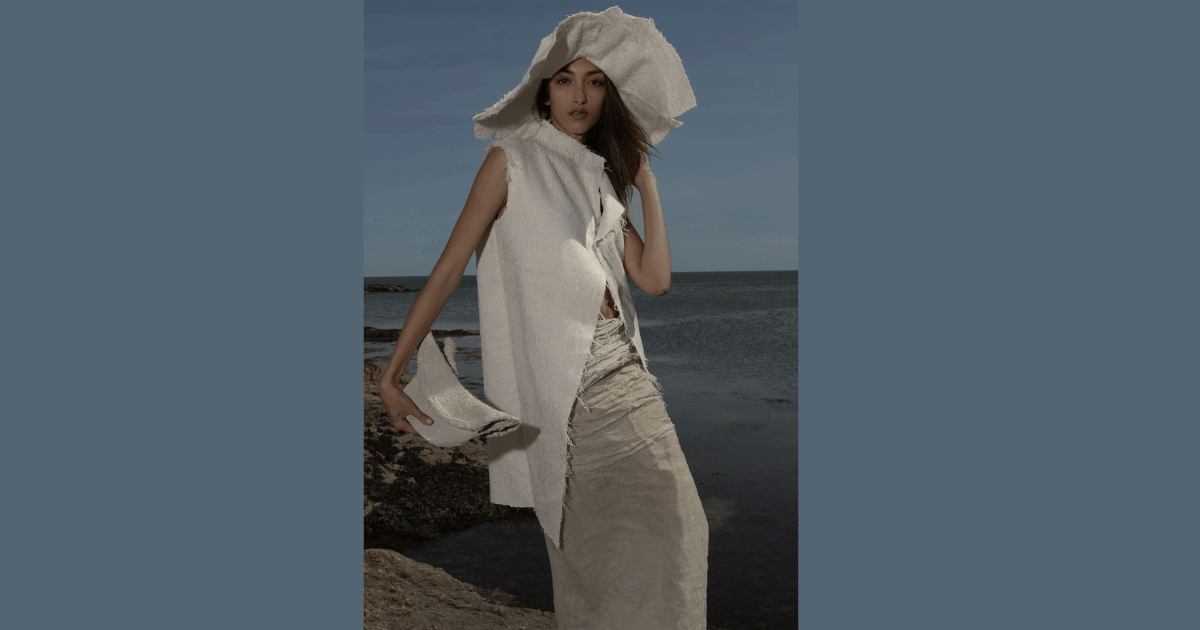
Material experimentation is particularly important to Wang’s argument. Linen, cotton, and raw silk establish a predominantly natural and lightweight foundation. Rather than forcing those materials into immaculate surfaces, Wang emphasizes their capacity to crease, shift, and respond to the body.
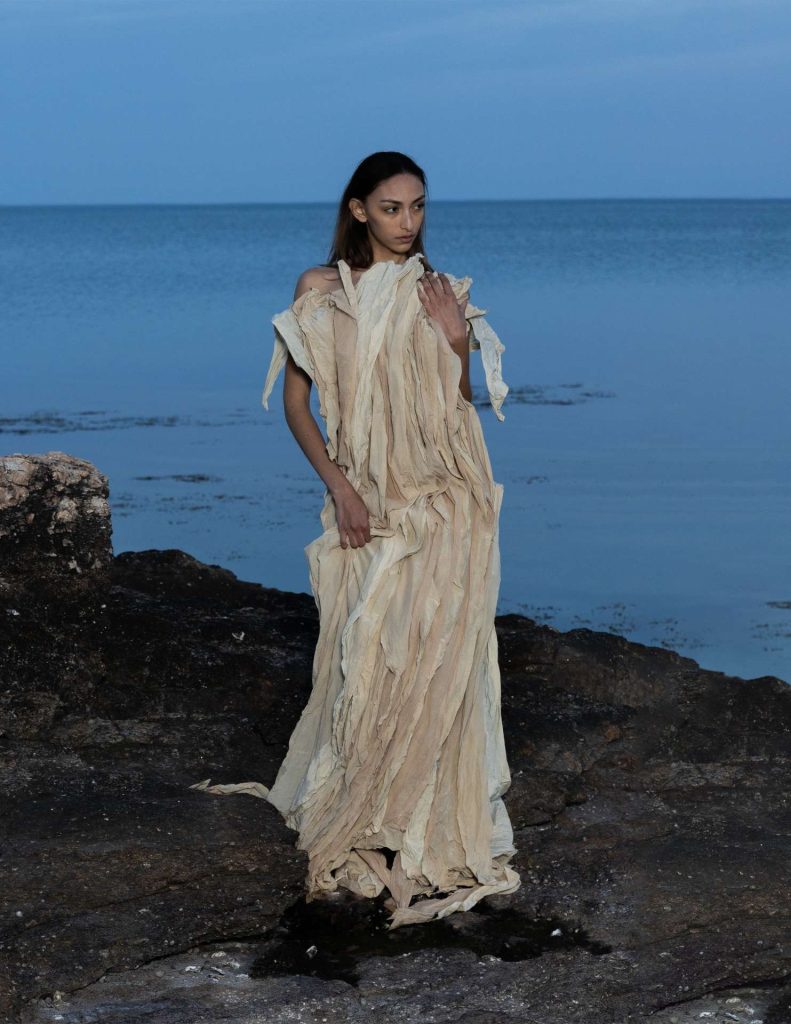
Most notable is a biodegradable textile treatment Wang developed to produce semi-permanent wrinkles and creases. The process turns what conventional garment care might regard as an imperfection into a permanent, or at least evolving, design feature. The resulting surfaces appear lived in rather than pristine; creases become evidence of manipulation, movement, and time.
Bamboo reed boning provides structure without relying exclusively on conventional rigid supports, allowing sculptural forms to retain a degree of flexibility. Natural dyeing processes using tree bark and acorns contribute to an earthy palette: sand, stone gray, soft white, muted earth tones, and deep black. The colors recall the collection’s landscape references without illustrating them literally.
The look titled “Rakes in Sand” demonstrates this approach, with layers of silk, cotton, and gauze treated with a stiffening technique that reflects the repetition and calm associated with raking gravel. Texture, repetition, and the interaction of layers create an effect that is tranquil but never static.
Wang developed the patterns and carried out the majority of the garment construction herself, remaining closely involved in how each material was manipulated and how every fold, crease, and structure interacted with the body. In a collection so dependent on folds, wrinkles, surface manipulation, and irregular construction, that authorship matters.
Here, craftsmanship is not simply a measure of technical execution, it functions as part of the concept. A fold can be positioned precisely yet still appear spontaneous. A sculptural silhouette can be engineered while retaining movement. A wrinkled surface can look accidental despite being intentionally produced. These effects depend on close decisions made during pattern development and construction rather than being applied as decoration after a garment has already taken form.
ZOEN: The Landscaper has received recognition across several juried design programs and categories. At the MUSE Design Awards the collection received Platinum recognition in Recycle/Sustainable Fashion and Gold distinctions in Textiles and Materials, Runway Collections, and Avant-Garde. The French Design Awards recognized the project with Gold awards in Textiles and Materials and Avant-Garde, alongside Silver recognition in Recycle/Sustainable Fashion. The NY Product Design Awards awarded the collection Gold in Womenswear and Silver in Sustainable Fashion.
The breadth of these categories reflects the different dimensions through which the collection can be read. ZOEN operates simultaneously as a study in textile manipulation, a sustainability-oriented material experiment, and a fully articulated womenswear collection. Its strongest moments occur where those elements cease to feel separate.
Despite the technical experimentation behind it, ZOEN is visually restrained. Wang largely avoids excessive ornament, allowing silhouette, proportion, texture, and material to carry the collection. This restraint prevents the conceptual framework from becoming overly literal; there are no obvious Zen-garden costumes here. Instead, references emerge through spatial relationships, muted colors, tactile surfaces, and the balance between rigid and fluid forms.
The collection also offers a practical example of how sustainability can function as a design methodology rather than a sourcing claim. The biodegradable wrinkle treatment and natural dyeing directly influence how garments look and feel, integrating environmental consideration into the aesthetic and making sustainable practice inseparable from formal decisions.
Ultimately, ZOEN: The Landscaper is less interested in presenting serenity as a finished condition than in examining the work required to continually create it. A garden is never permanently complete, it must be arranged, disturbed, maintained, and rearranged. Wang treats clothing, and by extension everyday life, in much the same way.
For a debut collection, ZOEN establishes a notably coherent vocabulary: restrained but tactile, architectural without becoming static, and sustainable in ways that are integrated into the physical construction of the clothes. Rather than attempting to eliminate disorder, Wang gives it structure and, in doing so, makes a case for imperfection not as a flaw but as one of the forces that gives a garment character.
Wang remains based in New York and continues to build on the processes and material techniques central to ZOEN. The project sets a clear foundation: an interest in hands-on making, material integrity, and a design logic that treats sustainability and craft as formal tools rather than add-ons. ZOEN is presented less as a final statement and more as a starting point for further exploration of how clothing can record time and action.