
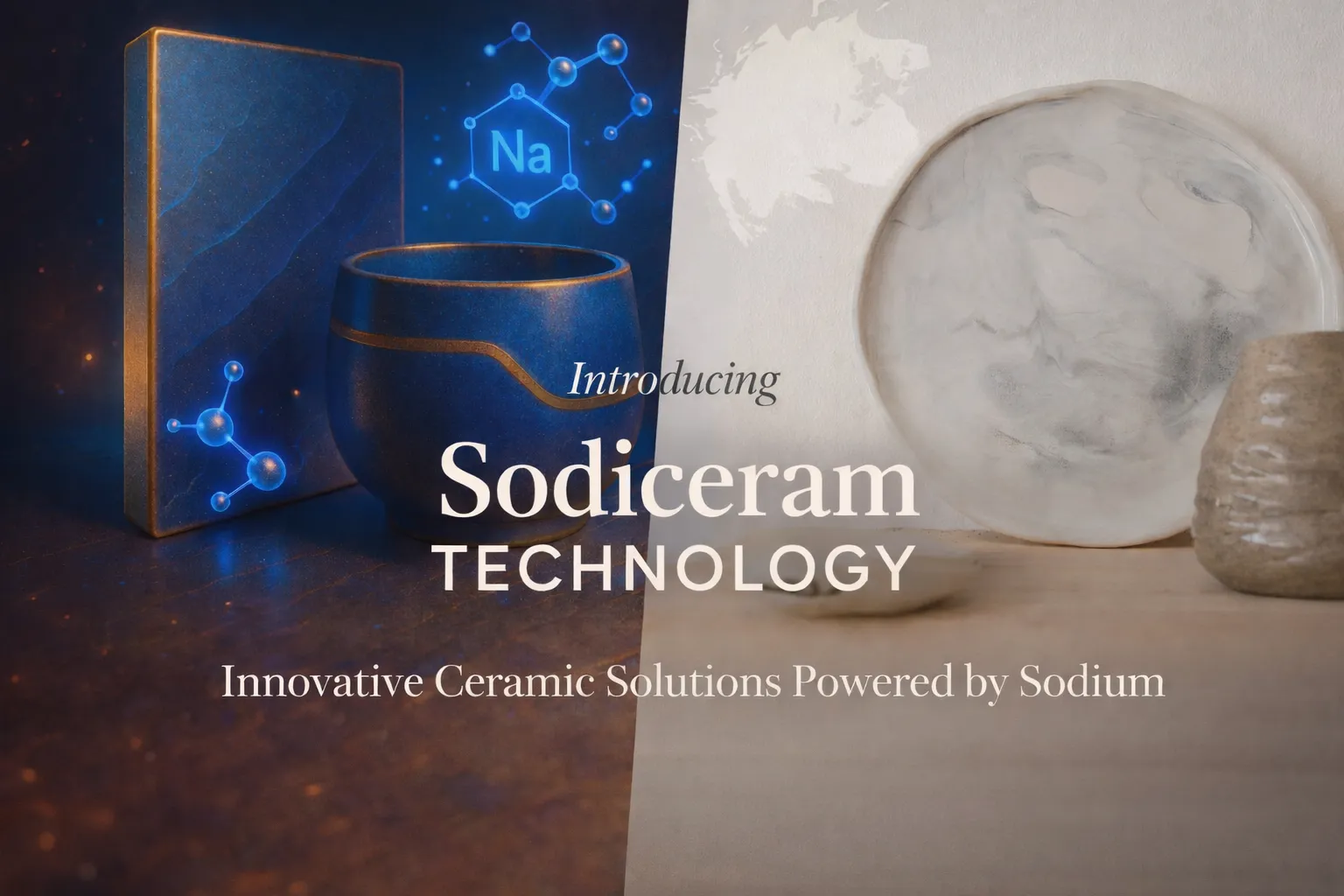
Ceramic materials have always occupied a critical space between art and engineering. They are valued for durability, heat resistance, and surface stability, yet they have historically struggled with limitations such as porosity, brittleness and restricted adaptability in demanding environments. However, as architectural and industrial expectations evolve, so must the materials that support them. This is where Sodiceram decisively enters the conversation.
Rather than modifying surface coatings or relying on external reinforcement, Sodiceram rethinks ceramics at the molecular level. It achieves denser vitrification, better structural cohesion, and increased design flexibility by directly incorporating Sodium-based chemicals into the ceramic matrix. Sodium-infused ceramics are therefore more than just a small enhancement. They signify a fundamental change in the design, production, and use of high performance ceramics.
At its core, Sodiceram is a next-generation Sodium-infused ceramic engineered to outperform traditional ceramic and porcelain materials across strength, porosity and thermal stability. This material incorporates regulated Sodium compounds to maximize vitrification and microstructural density, in contrast to traditional bodies that mostly rely on feldspar and kaolin.
This was not an accidental innovation. Researchers started reevaluating Sodium’s function as a fluxing agent as architects and engineers requested materials that could survive harsh conditions including chemical exposure and freeze thaw cycles. Laboratory breakthroughs in controlled glass phase development eventually led to industrial scale production. As a result, Sodiceram developed right at the intersection of advances in material science and practical performance requirements.
The term Sodiceram is intentionally literal. “Sodi” refers to Sodium, while “Ceram” denotes Ceramic composition. This naming reflects more than branding—it signals a foundational material shift. Sodium is not added as a superficial enhancer; it is embedded into the ceramic body itself, influencing melting behavior, grain bonding and thermal response during firing.
As a result, it distinguishes itself from porcelain or stoneware not by appearance alone, but by the chemistry that defines its performance envelope.
Sodiceram regularly reaches ≤0.5% porosity, whereas typical ceramics frequently maintain porosity levels between 1% and 3%. Lower water absorption, higher density and noticeably better resistance to frost, discoloration, and chemical intrusion result from this striking decrease.
Additionally, the flexural strength of Sodium infused ceramic is greater than 40 MPa which exceeds the mechanical limits of regular porcelain. Importantly, this strength does not sacrifice aesthetics. In contrast, Sodium infused ceramic maintains structural integrity while supporting a variety of finishes from high gloss polished surfaces to ultra matte industrial textures.
The performance leap of Sodium infused ceramic is rooted in precise ceramic chemistry. By carefully introducing Sodium based compounds, manufacturers enhance liquid phase sintering while controlling thermal expansion and crystallization behavior.
Sodium acts as a flux, lowering the melting point of silica and alumina. This enables densification at reduced firing temperatures, promoting tighter grain packing and minimizing micro cracks. However, success depends on balance. Excess Sodium can destabilize the structure, so formulation discipline remains very important.
Although Sodiceram builds upon traditional ceramic manufacturing, its success depends on meticulous control at every stage. Raw materials typically include kaolin clay, quartz, feldspar, alumina and Sodium carbonate or nepheline syenite as Sodium sources.
After ball milling ensures homogeneity, the mixture is spray-dried and pressed into tiles or slabs. Firing occurs at temperatures between 1150–1250 °C, where Sodium facilitates vitrification. Surface treatments—ranging from digital printing to polishing—are then applied, producing finishes comparable to engineered stone.
Sodium encourages the development of a linked glassy phase during firing which fills up the tiny spaces between crystalline grains. This glass phase growth efficiently blocks internal channels, preventing moisture or chemical penetration.
Scanning electron microscopy consistently reveals a uniform microstructure in Sodiceram, with glassy phases encapsulating crystalline components. As a result, bulk density often exceeds 2.3 g/cm³, delivering superior wear resistance and long-term dimensional stability.
Because of its controlled microstructure, Sodium infused ceramic excels under conditions that challenge conventional ceramics. Its coefficient of thermal expansion remains tightly regulated, allowing it to tolerate rapid temperature shifts of up to 200 °C without cracking.
Chemically, Sodiceram resists acidic and alkaline exposure far better than natural stone and even many vitrified tiles. Household cleaners, industrial agents and mild corrosives fail to etch or stain its surface. Mechanically, its Mohs hardness of 7 and PEI Class V abrasion resistance ensure reliability in high traffic environments.
Despite its advantages, Sodiceram remains a ceramic and ceramics are inherently brittle. Extreme point loads or improper substrate preparation can lead to localized fractures. However, when installed correctly with suitable adhesives and expansion joints, it consistently delivers service lives exceeding 50 years, outperforming many alternative surface materials.
The strength of Sodium infused ceramic lies in its versatility. In residential settings, it excels as flooring, wall cladding, countertops, and backsplashes. Its stain resistance makes it particularly suitable for kitchens while its low porosity discourages mold growth in bathrooms.
Commercially, Sodium infused ceramic thrives in airports, hospitals and shopping centers where abrasion resistance and hygiene are critical. Industrial facilities further benefit from its chemical stability in laboratories, cleanrooms, and processing plants.
In medical applications, it is used in medical devices and implants due to its biocompatibility, chemical stability and resistance to repeated sterilization. Its ultra-smooth ceramic surfaces reduce wear in joint replacements while maintaining precision in surgical tools and diagnostic equipment, supporting long term reliability and patient safety.
In modern electronics, Sodiceram serves as a high performance ceramic substrate that combines electrical insulation with efficient heat dissipation. Its stability under extreme temperatures makes it essential for heat sinks, semiconductor manufacturing and high density computing systems where thermal control directly impacts performance and lifespan.
Architecturally, it has become a preferred choice for ventilated façades and curtain wall systems. Its favorable strength-to-weight ratio enables lighter building envelopes without sacrificing durability.
Correct specification and installation are very important. Designers must account for slip resistance, thickness, mechanical loads and environmental exposure. Substrates should be flat and structurally sound, while flexible cementitious adhesives are necessary to accommodate thermal movement.
Expansion joints at regular intervals prevent stress accumulation. When these guidelines are followed, Sodiceram maintains its integrity with minimal maintenance and no need for surface sealing.
Sodium infused ceramic holds a premium mid tier position in terms of pricing. Even though it costs more than porcelain, it is still far less expensive than marble or manufactured stone. Crucially, its longer lifespan and reduced maintenance needs frequently translate into better lifecycle value.
Because Sodium fluxing lowers kiln temperature requirements, manufacturers also benefit from cheaper energy expenditures during firing. This effectiveness improves Sodium infused ceramic’s sustainability and commercial viability.
Sustainability is increasingly central to material selection and Sodium infused ceramic aligns well with green building objectives. Reduced firing temperatures cut energy consumption by up to 10%, while modern production facilities recycle water and minimize waste.
At end-of-life, it can be crushed and reused as aggregate. When lifecycle durability is considered, its embodied carbon per year of service is notably lower than that of many competing materials.
Compared to porcelain, Sodium infused ceramic offers lower porosity and higher chemical resistance. Against sintered stone, it provides comparable performance at a more accessible cost. Sodiceram advanced ceramic materials are used in high-stress aerospace and defense components, and also dominate the architectural and design sector by balancing high-performance durability with superior scalability and affordability.
Research continues to push Sodium infused ceramic forward. Smart surface integration—such as embedded sensors or heating elements—is already under exploration. Advances in pressing technology may soon enable ultra-thin panels as slim as 3 mm, reducing structural loads while preserving strength.
Additive manufacturing also holds promise. Ceramic 3D printing with graded Sodium content could enable custom density profiles, opening new possibilities for architectural and medical applications alike.
Ultimately, Sodiceram succeeds because it addresses long standing ceramic limitations at their source. By reengineering the ceramic body itself, it achieves durability, efficiency and design freedom without compromise. As we at Vogue Vocal observe, with global construction trends increasingly prioritizing sustainability, resilience, and lifecycle value, Sodium infused ceramic stands poised to define the next era of high-performance ceramic materials.
It is used in flooring, cladding, countertops, façades, industrial surfaces, medical devices and decorative architectural elements.
It offers lower porosity, higher mechanical strength, and superior chemical and thermal resistance.
Yes, it is frost-resistant, UV-stable, and ideal for exterior façades and terraces.
No. Its dense structure eliminates the need for sealing and simplifies long term maintenance.
With proper installation, it can last over 50 years with minimal degradation.

Are the men in house ready to take their style game up a notch? Aly at Vogue Vocal is the eyes and ears of entertainment industry with that Gen-Z x-factor! Aly’s personal style statement raises the bar high and knocks it out of the park so trust him for picking the best for Vocal Fashion, our e-magazine edit, the heart and soul of Vogue Vocal!